
Gin Rummy becomes much easier when you can point to every meld and explain every leftover card. This guide is for Indian readers who know a little about rummy but want a clear ten-card practice routine. You can follow the examples with a normal deck, a notebook and a friend. No account, deposit or app download is needed for these exercises.
Our seven lessons move from card values to complete hands, then to knocking and score checks. We use original examples and name the scoring convention wherever it matters. Different rulebooks can use different bonus values, so a familiar game name alone does not settle every rule. Browse the Lucky Games500 home page for other topics, and keep this worksheet handy while learning.

1. Start Gin Rummy with the correct deck and values
The ordinary two-player game uses one standard 52-card deck, without jokers, and ten cards per player. Keep the remaining stock face down and a discard pile face up. A normal turn adds one card to your hand and removes one card. The detail to remember is that ten cards form your settled hand; eleven is the temporary count after drawing.
For Gin Rummy, an ace counts as one, number cards count at their printed value, and J, Q and K count as ten each. Ace is low in runs: A♣ 2♣ 3♣ fits, while Q♣ K♣ A♣ does not. Do not transfer the ace-high sequence habit from an Indian rummy table into this exercise.
Write two separate headings on paper: rank and value. A king’s rank determines where it sits in a run, while its ten-point value matters when it remains unmatched. A ten and a queen both count as ten points, but they cannot replace one another in a sequence. Equal value is not equal rank.
A useful first drill is to shuffle five cards and total their values without arranging them. For A♦, 4♠, 7♥, J♣ and Q♦, the total is 1 + 4 + 7 + 10 + 10 = 32. That is only a counting exercise, not a complete hand. Repeat with different cards until the addition feels comfortable.
Read actual ranks, not decorative lettering
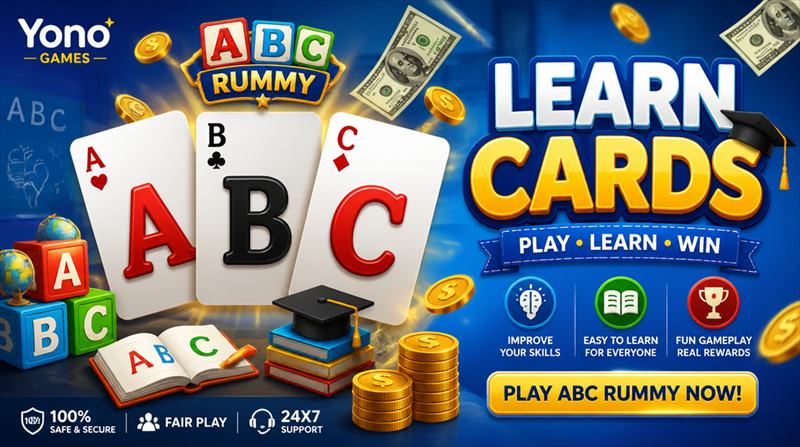
Artwork can help you remember to inspect a card, but it cannot replace a real deck. Gin Rummy uses A, numbered ranks, J, Q and K. If an illustration prints a made-up rank or a vague suit, leave it out of your worked hand. Use the written card notation in this guide for the exercises.
2. Recognise Gin Rummy runs, sets and deadwood
A run contains at least three consecutive ranks of one suit. A set contains at least three cards of one rank. Everything outside your selected melds is deadwood. These three labels give you a practical reading order: find complete groups, check whether they overlap, then add the unmatched values.
In Gin Rummy, 4♥ 5♥ 6♥ is a run, while 8♣ 8♦ 8♠ is a set. The same suits matter in the first example; matching ranks matter in the second. A group such as 4♥ 5♦ 6♥ has neither feature. It looks close to a run, but close is still unmatched.
Try this ten-card hand: 3♣ 4♣ 5♣; 9♥ 9♦ 9♠; A♦ 2♠ 6♥ K♣. The two three-card groups are melds. The four remaining cards have values 1, 2, 6 and 10, giving 19 deadwood. Count the cards as well: three plus three plus four equals ten.
Do not call a two-card pair a completed set. It can be a useful possibility for a later draw, but it is still deadwood now. Likewise, 6♦ 7♦ is an unfinished run. Labeling potential groups separately prevents a surprisingly common mistake: subtracting cards because you hope they will become useful.
For a simple Gin Rummy notebook, use three columns: completed meld, possible group and unmatched value. When a new card arrives, update the first column only if a full meld really exists. The notebook should describe the current hand, rather than the best hand you imagine drawing later.
3. Audit a Gin Rummy hand before choosing a discard
Good Gin Rummy practice starts with a complete inventory. Lay the hand out, read each suit carefully and count ten cards. After drawing, count eleven. After discarding, count ten again. This small habit prevents missing-card errors that make later deadwood calculations meaningless.
Consider 2♣ 3♣ 4♣; 7♦ 7♥ 7♠; 5♥ 6♥ Q♣ A♠. Before the draw, the unmatched cards total 22: five plus six plus ten plus one. If 7♥ were already in the hand, another identical 7♥ cannot arrive from a single standard deck. Correct deck assumptions matter when analysing possible draws.
Now draw 7♣ instead. You can make a four-card seven set and discard Q♣. The settled hand then has a three-card club run, a four-card seven set, and 5♥ 6♥ A♠ as deadwood. The new total is twelve. The improvement is real, but twelve is still above the usual ten-point knock limit.
Alternatively, from the original hand draw 4♥. It completes 4♥ 5♥ 6♥. Discard Q♣ and the ten cards become three melds plus A♠, giving one deadwood. These are alternative draws from the same starting position, not two draws in one turn. Keep the branches separate on paper.
When practising Gin Rummy, explain why your chosen discard helps. “It removes ten unmatched points while preserving three complete groups” is a better answer than “high cards are always bad”. A high card inside a completed run or set does not add deadwood, so its role matters more than its face value.
Check a pictured hand instead of trusting its headline

The picture offers a useful Gin Rummy reading exercise. Its three nines can form a set and its heart J-Q-K can form a run. The spade A-K-Q-10 group cannot form a run under the ace-low rule. A gold badge or the words “Perfect Hand” do not repair missing ranks.
This is why the examples here specify suits and card counts in text. A decorative fan of cards can look convincing while leaving basic rule questions unanswered. If you cannot identify every printed rank and suit, you cannot calculate the hand reliably. Move back to a real deck or clear written notation.
4. Follow the Gin Rummy draw-and-discard order
After the opening upcard procedure, a normal turn means taking the top stock card or top discard, then discarding. You cannot pick up the top discard and immediately return that same card as your discard. The visible discard therefore deserves a little thought before you take it.
For this Gin Rummy exercise, imagine holding 5♠ 6♠ and seeing 7♠ on the discard pile. Taking it completes a run. Identify the card you will remove before making the move, then recalculate the ten-card hand. A useful draw can still leave a poor discard choice if you stop checking too soon.
Next imagine seeing 8♠ instead. Your 5♠ 6♠ 8♠ does not form a run because seven is missing. You may decide to retain it as a future possibility in a practice game, but do not count it as a completed meld. A single gap is enough to change the calculation.
At home, say “draw, arrange, discard, recount” aloud for a few rounds. The words slow the sequence just enough to make errors visible. On a small mobile screen, inspect the suit symbol as well as the colour. Hearts and diamonds share a colour but cannot mix within a run.
Gin Rummy decisions also involve hidden information. The stock order and your opponent’s full hand are unknown. Seeing one attractive card does not prove the next one will arrive. Keep any practice observation separate from a prediction, and avoid treating a discard pattern as a guaranteed result.
5. Understand Gin Rummy knocking before announcing it
In the common convention used for these Gin Rummy exercises, you may knock with ten or fewer deadwood points after the discard. Knocking ends the round for comparison. It does not automatically mean you have won. A hand with six unmatched points can still lose the comparison.
Take a settled hand with runs 2♥ 3♥ 4♥ and 8♣ 9♣ 10♣, a set 5♦ 5♣ 5♠, and A♠ left over. It has ten cards and one deadwood point. All three groups are complete. The ace is unmatched even though it is a low-value card.
For another Gin Rummy example, suppose your unmatched cards are A♦ 3♠ 6♣. Their total is ten, exactly at the usual knock boundary. Replacing six with seven produces eleven, above that boundary. “Only three cards left” is not the relevant test; their point total is.
Before knocking, reconstruct your melds once more and make sure each physical card appears once. If the hand can be arranged in two ways, calculate both. One arrangement may produce a lower deadwood value. Do not let a visually neat row hide a worse grouping.
Gin means no deadwood after the normal discard. Some versions also recognise Big Gin when all eleven cards meld before discarding. Treat that as a separate rule to check, rather than assuming every version offers it. For first practice sessions, ordinary knocks and ten-card Gin are enough.
6. Calculate Gin Rummy layoffs and scores carefully
These Gin Rummy examples use a common convention in which the opponent may lay off eligible cards after an ordinary knock, but cannot lay off after Gin. A layoff extends an existing meld. It does not create a new independent meld from unrelated cards.
If the knocker shows 4♣ 5♣ 6♣, an opponent’s 7♣ can extend that run. A 7♦ cannot. If the knocker has 9♥ 9♣ 9♠, the remaining 9♦ can extend the set in a single-deck game. Check these possibilities before comparing final deadwood totals.
Suppose the knocker has six deadwood. The opponent initially has 23, including 7♣, and can lay that card onto the exposed club run. Their remaining total becomes 16. The ordinary knock difference is then 16 − 6 = 10, rather than 23 − 6 = 17.
For an undercut example, the knocker has eight and the opponent ends with five. The opponent has the lower total, so the knocker is undercut. With an agreed 25-point undercut bonus, the opponent scores 25 + (8 − 5) = 28. With a ten-point bonus convention, the same cards give thirteen instead.
For Gin, assume the opponent has 18 deadwood and the agreed Gin bonus is 25. The result is 18 + 25 = 43 points for the player going Gin. Another rulebook may use a different bonus. These are points in a learning exercise, not a cash value or payment promise.
Make your Gin Rummy score sheet show the convention at the top. Record who ended the round, whether it was an ordinary knock or Gin, both final deadwood totals, any permitted layoffs, the bonus and the resulting score. A transparent line of arithmetic is easier to review than a single unexplained total.
7. Use a short practice worksheet
For your first Gin Rummy worksheet, write 6♥ 7♥ 8♥; 4♣ 4♦ 4♠; A♣ 2♦ 3♠ Q♥. Ask a friend to find the melds and total the rest. The answer is sixteen deadwood: one plus two plus three plus ten. There are ten cards altogether.
Question two changes only Q♥ to 4♥. Now the four fours form a set, alongside the three-card heart run. The remaining A♣ 2♦ 3♠ total six. They do not form a run because their suits differ. The new hand meets the usual knock limit, but its comparison outcome is still unknown.
Question three uses 2♠ 3♠ 4♠; 6♦ 7♦ 8♦; 10♣ 10♦ 10♥ 10♠. There are ten cards, all in melds, with zero deadwood. This is a settled Gin hand. Notice that a four-card set is possible even though a five-card same-rank set is not possible in the single standard deck.
Finish each Gin Rummy session with one correction you can describe. Maybe you mixed suits, counted an ace as ten, or reused a card in two groups. Re-deal that example and explain the repaired version. Ten careful minutes can teach more than many hurried rounds with no review.
Keep the website identity separate from the game rules

A Gin Rummy tutorial explains a card game. It does not certify a similarly named app or confirm its withdrawals, rewards or publisher. Those questions require separate evidence. Keep your notebook exercises free of payment assumptions and use the site home page to choose your next reading topic.
Try an overlapping-meld puzzle
Here is a useful Gin Rummy puzzle for your notebook: 3♣ 4♣ 5♣ 6♣; 5♦ 5♥; 9♠ 9♥ 9♦; K♦. One arrangement keeps the four-card club run and the nine set. The remaining two fives and king total twenty. Count four plus three plus three leftover cards to confirm ten.
A different arrangement uses 3♣ 4♣ 5♣ as the club run, leaving 6♣ beside the two fives and king. That totals 26, so shortening the run without gaining another meld makes this arrangement worse. The comparison is about the whole hand, not the appearance of a single group.
You might want to use 5♣ with 5♦ and 5♥ as a set. However, removing it breaks the club group into 3♣ 4♣ and an isolated 6♣. The nine set remains complete, but the unmatched three, four, six and king now total 23. The first arrangement still gives the lowest deadwood among these three choices.
Circle the lowest total only after checking all ten physical cards. For Gin Rummy practice, this is a helpful way to discover why automatic sorting or a neat-looking row should still be reviewed. You can repeat the puzzle by changing the king to another rank and testing which groups become possible.
Gin Rummy questions Indian beginners often ask
Do I need two sequences like Indian rummy?
No. Do not import the thirteen-card declaration requirement into this ten-card game. Build valid sets and runs, then calculate the cards left outside them. The hand structure and ending rule you are practising determine the result.
Is an ace always one point here?
Yes, in these ordinary Gin Rummy exercises. That affects both deadwood arithmetic and ace-low runs. A low unmatched ace still contributes one point; it does not disappear merely because its value is small.
Can one card belong to two melds?
No. Draw alternative arrangements on separate lines and choose one complete allocation. If 5♣ helps both a club run and a five set, the same physical card cannot complete both simultaneously.
Does knocking guarantee the round?
No. The opponent may finish with equal or lower deadwood under the applicable layoff rules. That is why you compare final totals and check the agreed undercut convention before writing the score.
What should I remember first?
Start with ten cards, recognise real melds, and add only unmatched values. Then practise the draw-and-discard order and one score example. Clear card reading is the foundation; decorative banners, app names and reward slogans cannot substitute for it.
